Federal tax incentives have played a critical role in making commercial solar financially viable for property owners for decades. However, with new rules taking effect over the next two years, timing has become just as important as design or location. Several upcoming changes will influence project economics, procurement, and eligibility for the Investment Tax Credit (ITC). This article explores what’s changing and why early action helps protect long-term project value.
New ITC Rules: What Matters for Commercial Solar Projects
The One Big Beautiful Bill (OBBB) created a timeline for discontinuing the current ITC structure for solar projects. Commercial systems can still qualify for the credit, but only if they meet specific timing requirements. In order to qualify for the credit, a project must either begin construction by July 4, 2026, or achieve commercial operation by December 31, 2027. These dates create a finite window for property owners evaluating on-site solar for their buildings.
Understanding FEOC: A Second, Earlier Deadline
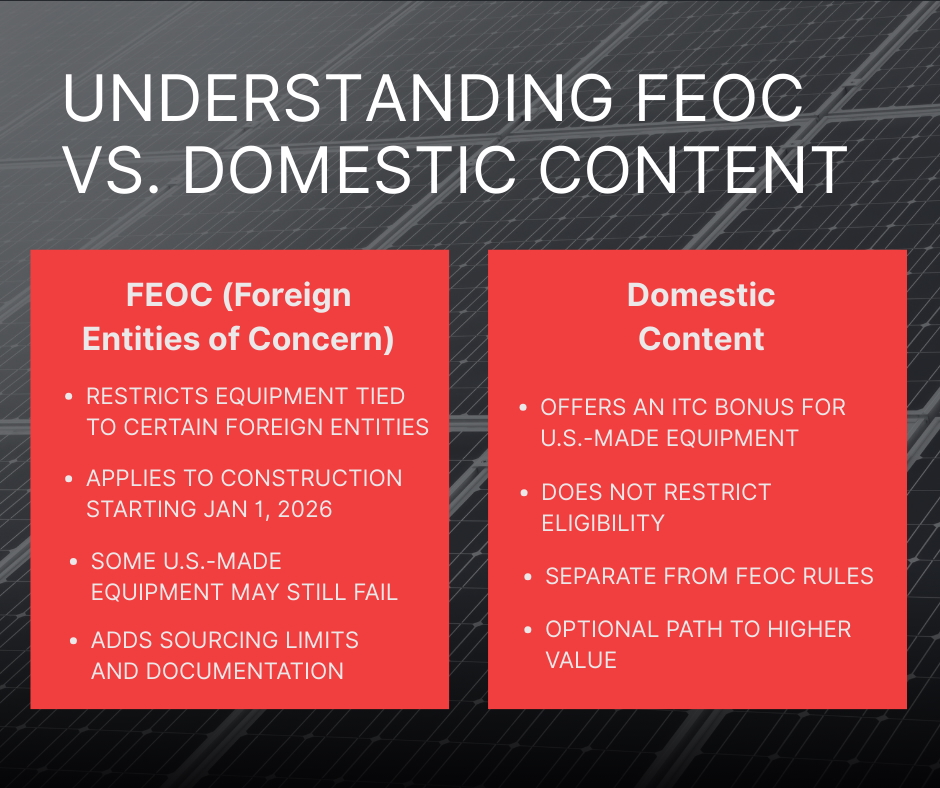
In addition to the ITC sunset, new rules on “material assistance” from Foreign Entities of Concern (FEOC) goes into effect on January 1, 2026. While FEOC requirements already exist today, most notably through rules governing Prohibited Foreign Entities (PFEs), these new provisions introduce additional restrictions tied specifically to equipment sourcing. Projects already under construction by December 31, 2025, are exempt from these rules, but anything started after that date may face added restrictions tied to equipment sourcing.
FEOC requirements are often confused with the better-known Domestic Content incentive, but they serve a different purpose. Domestic Content rewards projects for using U.S.-made equipment. “Material assistance” under FEOC, on the other hand, disallows the credit qualification if components from certain restricted countries exceed certain limits. Even if a product is manufactured domestically, it could fail FEOC compliance if it includes materials or corporate affiliations linked to China, Russia, Iran, or North Korea.
How Safe Harbor Protects a Project’s Tax Credit Eligibility
Safe Harbor gives commercial solar projects a pathway to lock in tax credit eligibility ahead of upcoming deadlines. The current rules place more emphasis on when construction is considered to have started, so the definition of “beginning construction” now determines whether a project keeps access to the credit.
What Qualifies as “Beginning Construction”
There are two recognized methods for meeting the “begin construction” requirement, depending on system size.
For projects under 1.5 MWac, the IRS still allows the 5 percent test. This means that at least five percent of total project costs must be incurred before the deadline. Qualifying expenses must be specific, documented, and directly tied to the project – such as equipment purchases, engineering, or interconnection costs. Generic deposits, feasibility studies, and capital expenditures not directly part of the system do not count. The project must also show a clear intent to move forward without unreasonable delay.
For systems over 1.5 MWac, the 5 percent test no longer applies. These projects must instead meet the Physical Work Test, which requires that construction has materially started under a binding written contract. Acceptable work may include foundation installation, trenching, or rack mounting on-site, or off-site manufacturing of custom components under a binding contract. Activities like permitting, site prep, engineering, and inventory purchases do not qualify. The work must reflect physical progress toward system completion, not just preparatory steps.
The Continuity Requirement
It is important to note that beginning construction is not enough on its own. To maintain eligibility, the project must also show continuous progress toward completion. The IRS provides a default “Continuity Safe Harbor” by allowing a four-year window. If the project is placed in service within four calendar years of the year construction began, continuity is presumed. For instance, construction that begins in 2025 must be completed by December 31, 2029.
Projects that fall outside this window may still qualify but must meet a facts-and-circumstances test. The IRS has clarified that certain delays will not count against continuity – including severe weather, interconnection issues, permitting delays, specialized equipment shortages, labor stoppages, and financing setbacks tied to documented supply disruptions. These exceptions are intended to account for unavoidable disruptions but are expected to be applied narrowly.
Projects that don’t meet Safe Harbor thresholds must still be placed in service by December 31, 2027, to qualify for the ITC under current rules.
Practical Steps to Keep a Project Eligible for the ITC
As the July 2026 deadline approaches, commercial property owners still have a short window to preserve full tax credit eligibility if they act quickly and strategically. Projects that begin construction before July 4th will remain eligible for ITC.
For projects not yet under construction, priorities include:
- Finalizing interconnection and community solar applications immediately. These often require weeks or months of lead time. Delays here can prevent projects from qualifying under the current rules.
- Documenting at least five percent of the spend for systems under 1.5 MWac. Spend must be traceable to project-specific components or services, must be under a pre-existing written contract, and economic performance must have occurred, such as title transfer.
- Initiating qualifying physical work or custom equipment production under a binding contract for systems over 1.5 MWac. Work must meet the Physical Work Test – not permitting, design, or inventory orders.
- Building a continuity plan that includes realistic timelines, procurement contingencies, and clear documentation practices.
For projects already under construction, the focus shifts to:
- Maintaining momentum toward completion. Projects placed in service within four calendar years of their construction start date will meet the continuity requirement automatically.
- Tracking delays carefully. If disruptions arise due to interconnection, equipment availability, labor, or permitting, ensure they are clearly documented and tied to recognized excusable events.
With limited time remaining before ITC deadlines take effect, commercial owners should move forward efficiently in order to optimize financial value. Projects that meet Safe Harbor thresholds now will be protected from future sourcing constraints and better positioned to realize the full economic benefit of commercial solar.
We recommend that you ensure qualification under these standards under the advice of tax counsel. We are not providing formal tax advice.
A Confident Path Forward for Commercial Solar
Even as tax credit rules evolve, commercial solar still makes sense. For property owners, the fundamentals haven’t changed – solar continues to increase long-term property value, support ESG goals, and provide predictable financial returns. What’s changed is the need for greater caution around timing, documentation, and eligibility.
With nationwide experience and a model built for long-term partnership, King Energy helps commercial property owners navigate shifting requirements without adding complexity. That’s what keeps solar projects moving forward, even as regulations and incentives continue to shift.
Contact King Energy
Ready to protect project eligibility ahead of upcoming deadlines? Contact King Energy today to request a site review and proposal.