For commercial property owners evaluating solar in Maryland, the limiting factor has rarely been economics; it has been the application process. For years, long timelines, overlapping approvals, and rigid sequencing between state programs and utilities created uncertainty that slowed otherwise attractive projects. That environment is changing.
Maryland has introduced meaningful, practical improvements to how community solar projects move from application to operation, while state leadership has doubled down on affordability, local power generation, and long-term clean energy planning. The result is a solar market that is beginning to align with how commercial real estate owners actually make decisions, based on timing, risk management, and predictable outcomes.
Why Maryland Matters for Solar
Maryland occupies a unique position among East Coast solar markets. It is densely developed, utility-constrained, and highly regulated, yet it has also been deliberate in designing programs that expand access to clean energy while maintaining grid reliability and consumer protections. For commercial properties, this has long created a compelling opportunity to monetize underused rooftops while supporting tenant energy savings.
At the same time, that same regulatory sophistication historically introduced friction. Multiple approval bodies, formal review processes, and conservative utility timelines made solar feel administratively heavy even when the financial case was strong. In recent years, however, Maryland has worked to reduce that friction without sacrificing oversight.
The electricity regulatory framework overseen by the Maryland Public Service Commission increasingly emphasizes transparency, coordination, and long-term system planning, setting the stage for more efficient solar development across the commercial sector.
Maryland’s Community Solar Program: Structure and Intent
Maryland’s community solar program has undergone a formal transition from pilot initiative to permanent market structure, providing greater long-term clarity for commercial property owners and developers alike. In 2023, the Maryland General Assembly passed House Bill 908, establishing a permanent community solar program to replace the prior pilot framework.
For commercial property owners, the results of this transition are significant. A permanent program replaces uncertainty with defined rules, clearer timelines, and an administrative framework designed for longevity rather than experimentation. The Public Service Commission’s overview of the community solar program outlines eligibility requirements, subscriber structures, and program mechanics that now reflect this permanent status.
In practical terms, Maryland’s community solar program enables a single solar installation to serve multiple off-site subscribers, including commercial tenants and local businesses, without requiring on-site load alignment. Property owners host the system, avoid capital investment, and receive long-term rental income, while subscribers receive discounted electricity through shared generation under a state-regulated framework built to endure.
Application Process Improvements That Reduce Friction
One of the most meaningful changes for commercial solar development in Maryland has been an improvement in the application process. Historically, projects often followed a sequential path, with community solar program review occurring first and utility interconnection review beginning only after acceptance. Each step carried its own queue and review timeline, extending the total project duration and increasing uncertainty around in-service dates.
Today, that rigidity has eased. Community solar program review and utility interconnection can now progress in parallel, allowing projects to advance multiple approval tracks at the same time. While incremental on paper, this change has a material impact in practice. Parallel applications reduce idle time between reviews, shorten the overall path from agreement to operation, and improve planning certainty for property owners and tenants.
This evolution reflects a broader recognition by regulators and utilities that process efficiency matters, particularly for infrastructure expected to operate for decades. It is a practical shift that makes Maryland’s solar market more compatible with commercial real estate timelines.
Pro-Solar Leadership and Clear Policy Direction
Maryland’s operational improvements are reinforced by clear policy signals from state leadership. Governor Wes Moore has framed clean energy deployment as both an affordability strategy and an economic development tool. In announcing the Lower Bills and Local Power Act, the administration emphasized expanding access to affordable, locally generated energy as a direct response to rising utility costs.
This direction was further reinforced through an executive order focused on lowering energy costs, protecting consumers, and accelerating the delivery of affordable energy solutions statewide. For commercial property owners, the significance of this leadership is less about politics and more about stability. Long-term solar investments benefit from consistent, pro-deployment policy environments, and Maryland has been explicit about its commitment to that path.
Capital Commitments Reinforce Long-Term Intent
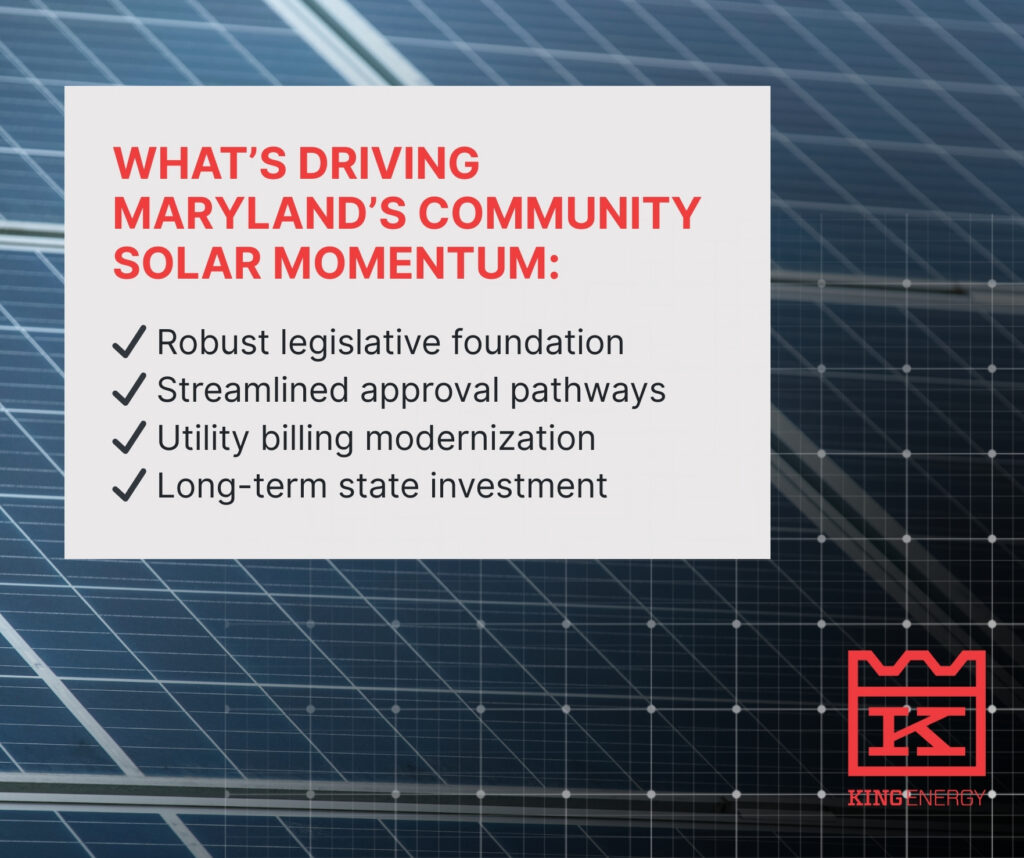
Policy direction alone does not move projects forward without capital alignment. In conjunction with its robust regulatory and executive actions, the state has also launched the Solar and Energy Storage Gap Financing Program fund: a $70 million commitment to a solar and energy storage financing program designed to accelerate project development and deployment.
For the commercial solar market, this investment signals that Maryland views solar as infrastructure, not experimentation. Capital availability, regulatory clarity, and administrative efficiency working together reduce development risk and support scalable deployment. That combination is particularly relevant for commercial portfolios evaluating solar across multiple sites, where repeatability and predictability matter as much as individual project returns.
What This Means for Commercial Property Owners
Taken together, these changes point to a Maryland solar market that has matured. The economics of community solar were compelling before, but the improved application process, clear policy backing, and committed capital environment reduce the non-financial risks that often stall decision-making. For commercial property owners, the implications are practical: faster timelines, clearer expectations, and greater confidence that projects will move from concept to operation without unnecessary delay.
Community solar remains a sensible way to unlock value from underused rooftops while supporting energy savings, particularly when paired with an experienced partner that manages permitting, applications, interconnection, billing, and long-term operations. King Energy is committed to installing, owning, and operating community solar systems nationwide, paying property owners long-term rent and delivering discounted power to tenants through enterprise-grade billing infrastructure.
How King Energy Helps Maryland Property Owners
King Energy’s model supports the broader goals embedded in Maryland’s community solar program. By serving commercial tenants, small businesses, and local subscribers, projects create shared economic value while aligning with the state’s focus on affordability and local energy generation. King Energy’s long-term ownership model ensures systems are actively monitored, optimized, and maintained throughout their operating life.
King Energy’s enterprise-grade OneBill™ platform is purpose-built for multi-tenant commercial properties, supporting accurate allocation, billing, and reporting across diverse subscriber bases. As Maryland advances toward consolidated billing, this infrastructure helps reduce administrative burden for owners while improving transparency and energy cost predictability for tenants.
With a nationwide footprint across multiple regulated markets, King Energy brings Maryland property owners proven execution experience and financial durability. The company’s long-term partnership approach is designed to complement Maryland’s permanent community solar program, delivering consistent income, operational simplicity, and a solar strategy that makes sense over decades, not development cycles.
If you are a property owner evaluating whether community solar makes sense within your Maryland portfolio, contact King Energy to discuss the possibilities with us.
Frequently Asked Questions
How long does the Maryland solar application process take today?
Timelines vary by utility and project specifics, but the ability to advance community solar review and utility interconnection concurrently has reduced overall development duration compared to older, strictly sequential approaches.
Do property owners need to invest capital upfront?
In a community solar structure like King Energy’s, property owners typically invest no upfront capital. The system owner finances, installs, owns, and operates the system.
Who can subscribe to community solar projects?
Subscribers can include commercial tenants, small businesses, and residents, allowing multi-tenant properties to support a broad mix of participants.
Is Maryland likely to remain supportive of solar long-term?
Recent legislation, executive action, and state-backed financing indicate sustained support focused on affordability and local energy generation.