Energy statements are rarely intuitive, and when solar is added, they can feel even harder to follow. Charges from the utility, solar energy line items, savings calculations, and cumulative totals often appear on the same statement, which leads many customers to ask a simple question: “Am I actually saving money?”
This guide explains how to read a King Energy OneBill™ energy statement in a clear, practical way. It is based on the same explanations King Energy’s customer support team uses every day, and it reflects the most common questions that come up when a system first goes live.
The goal is clarity, not complexity. Our OneBill™ billing statements make it clear where the numbers come from, how solar savings are calculated, and why comparing one statement to another without context can be misleading. When the statement makes sense, your savings from solar energy become easier to see.
Download a full annotated statement here to follow along!
Why Energy Statements Feel Complicated at First
Most commercial utility bills were designed to show one thing: how much energy your business used from the grid. Once solar is introduced, the bill needs to account for both energy supplied by the grid and energy generated on-site by solar.
Because of this, the statement now needs to reflect how energy from these two sources works together to power the building and how solar generation offsets electricity that would otherwise be purchased from the utility.
Understanding how utilities structure energy costs helps explain why this happens. Electricity bills generally combine generation charges, delivery charges, taxes, and regulatory fees, all of which can change independently.
Click here to download an annotated OneBill™ energy statement that we’ll walk through together below.
King Energy OneBill™: A Complete Page-By-Page Breakdown
1) Your Account Summary: Overview of Solar vs Grid
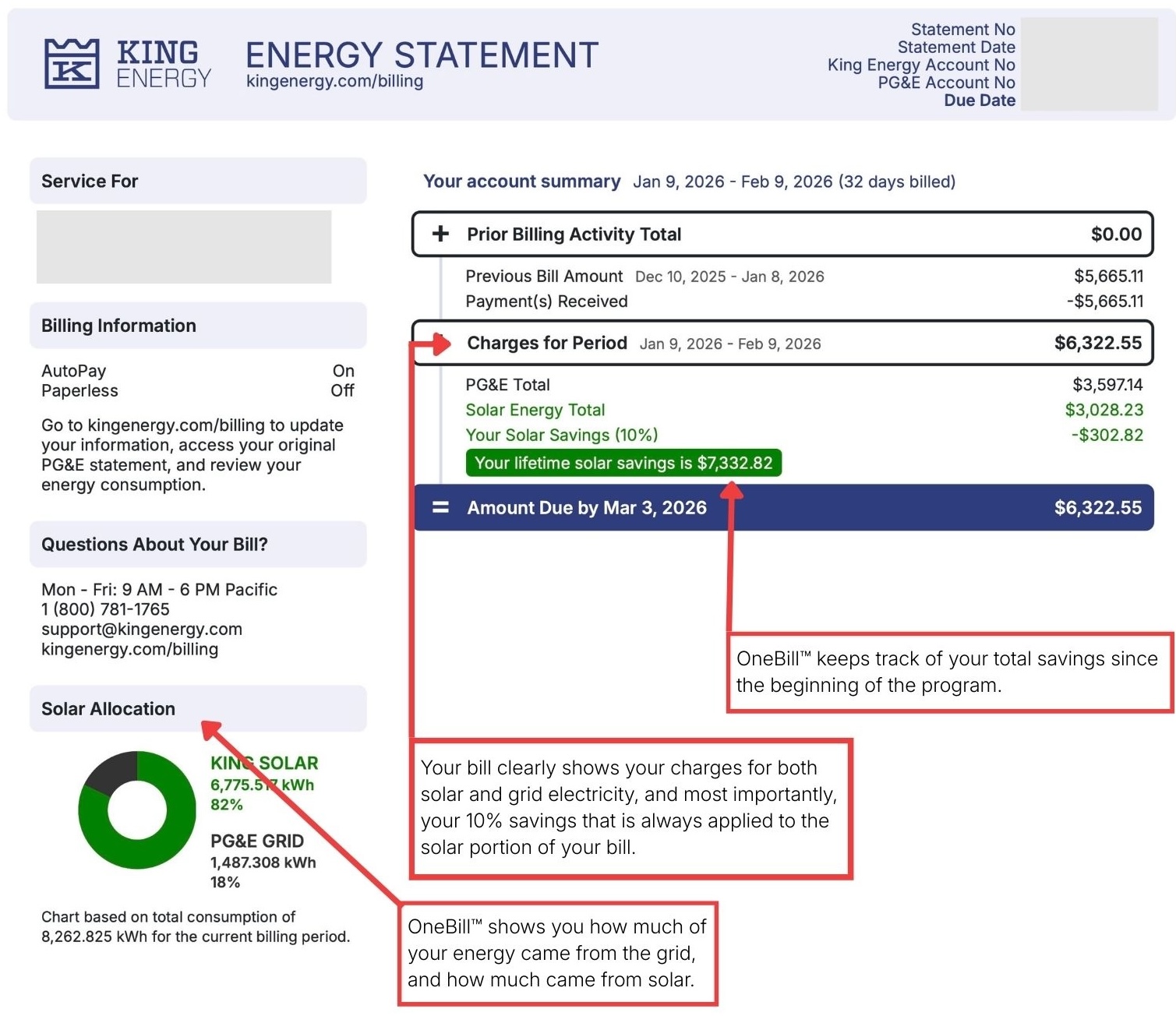
A King Energy OneBill™ statement is designed to detail all of your energy costs in one place, allowing customers to make a single payment per billing cycle. For most small businesses, this means there is no need to pay the utility directly.
This is why your statement looks different than it used to: King Energy now manages your utility account and consolidates those costs on your OneBill™ statement.
Your OneBill™ statement includes:
- The cost of the electricity supplied by the utility grid
- The retail value of the solar energy used during the period.
- A 10% discount applied to the solar energy portion.
- A cumulative lifetime savings-to-date total.
- A summary showing what the bill would have been without solar (found at the top of page two of your OneBill statement).
For larger nationwide accounts or customers that use third-party bill payers, billing may be structured differently. Some customers may elect to have their solar energy billed separately from their utility provider; this can be arranged at any time by contacting King Energy’s support team. Regardless of billing structure, the underlying calculation of solar savings remains the same.
How Your Statement Shows Savings from Solar Energy
Solar energy is billed by the kilowatt-hour (kWh) using the same rates your utility uses for electricity from the grid. A 10% discount is then applied to the solar energy used. That discount is fixed. What you will see change month to month is how much solar energy is generated and applied to your meter.
Your OneBill™ statement breaks down where your energy comes from and how much that energy costs, step by step:
On page one of your bill, you’ll see:
Utility Total (After solar credits have been applied)
Shows the cost of electricity supplied by the utility grid, separate from the solar energy applied to your meter.
Solar Energy Total (Before Savings)
Shows the retail value of the solar energy generated and applied to your meter, using the same rates your utility charges for grid electricity.
Your Solar Savings (10%)
Applies the fixed 10% discount to the solar energy used.
Together, the Solar Energy Total and Your Solar Savings figures show the retail value of the solar energy applied to your meter and the discount applied to that energy.
Lifetime Savings and the Solar Allocation View
Your statement includes a Lifetime Savings to Date figure. This is not a projection; it represents the cumulative total of your monthly savings since the program began.
The statement also includes a graphic showing how much of your energy use was supplied by the on-site solar array versus the utility grid. This helps explain why savings fluctuate seasonally. In months with higher solar production (May – September), a larger percentage of solar is used, which increases savings. In lower-production months (November – February), solar use decreases, and savings adjust accordingly.
2) Summary of Charges: Your Total Before Savings
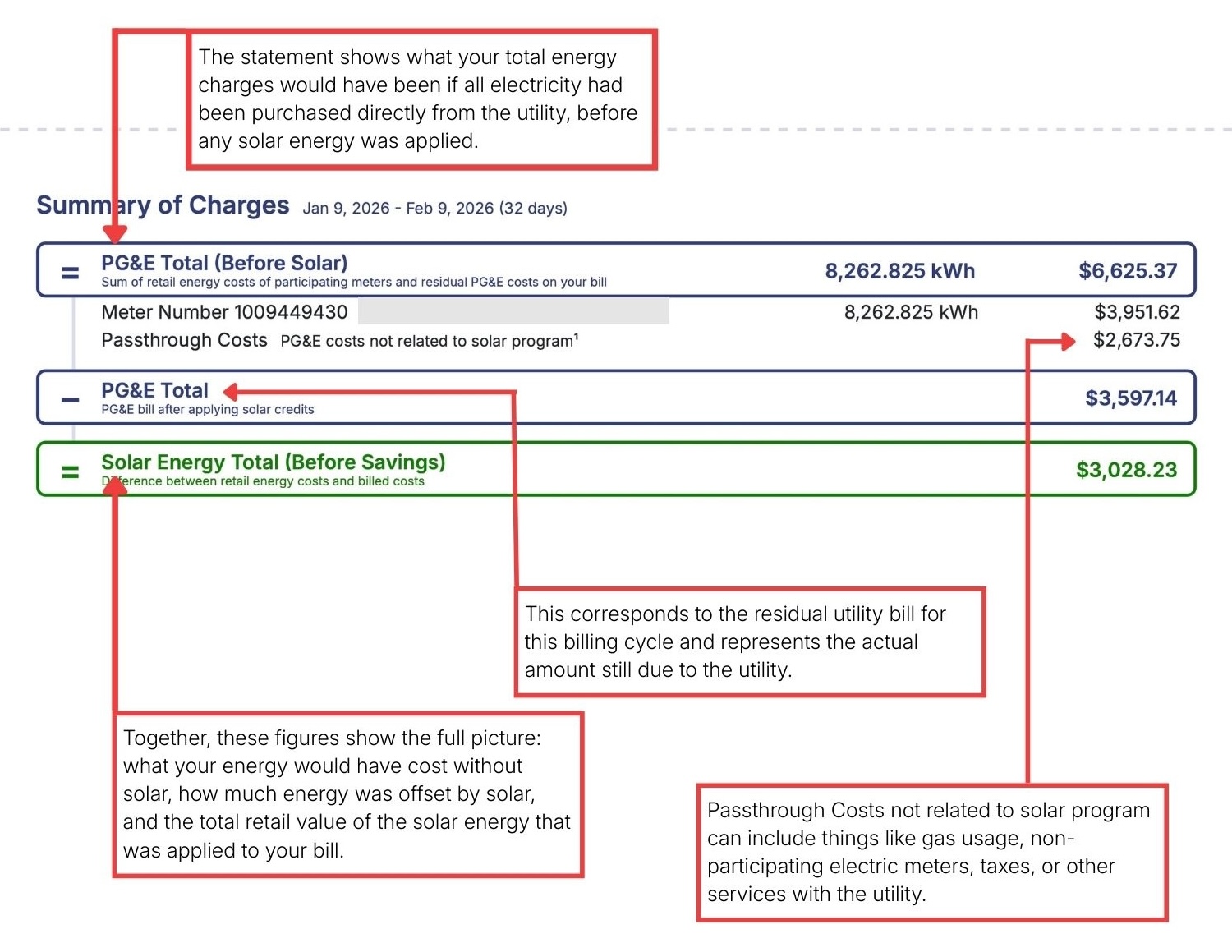
The Summary of Charges is designed to give a clear, high-level snapshot of how solar impacts your energy costs for the billing period. Rather than showing every individual rate or line item, this page focuses on the totals that matter most.
- At the top, the statement shows the Utility Total (Before Solar), which is what your total energy charges would have been if all energy had been purchased directly from the utility, without any solar energy being applied. This represents the full “retail cost” of your energy use for the period .
- Next, the statement shows the remaining Utility Total after solar energy has been applied. This is what your utility bill actually was and is the portion of your energy use that was not offset by solar and was still supplied by the utility.
- Finally, the Solar Energy Total is the difference between what your bill would have been and what it actually was, thus specifying the retail value of the solar energy used during the period, before discounts are applied.
Together, these figures show the full picture: what your energy would have cost without solar, how much solar energy was supplied, and how that translates into real savings on your total bill. This page is meant to make it easy to see the financial impact of solar at a glance before diving into the detailed breakdown on the following pages.
3) Actual Usage for Meter: Detailed Energy Consumption Data
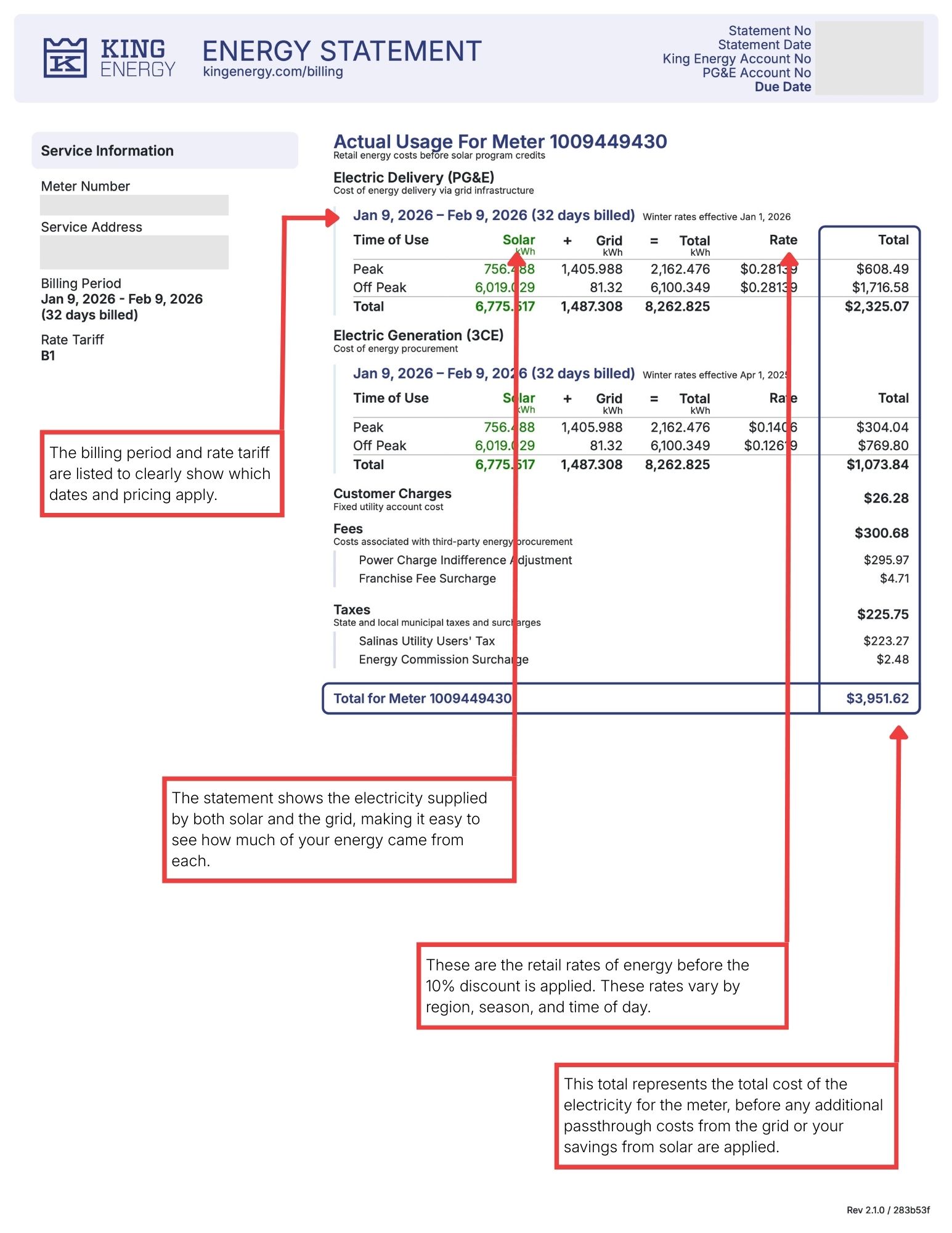
The Actual Usage for Meter page provides a detailed breakdown of how much electricity your business used during the billing period and how that usage was split between solar energy and grid energy.
At the top of the page, the billing period and rate tariff are listed so it is clear exactly which dates and pricing apply. Below this, usage is split into the time of use categories determined by your utility provider. This affects the cost of electricity based on user demand throughout the day.
For each time period, the statement shows three values side by side:
- The kilowatt hours (kWh) supplied by the solar array,
- The kilowatt hours (kWh) supplied by the grid, and
- The total kilowatt hours (kWh) used.
This makes it easy to see how much of your energy was covered by discounted solar and how much came from the utility grid.
At the bottom of the page, the Total for Meter, which is the total retail cost for the meter, is shown before solar savings are applied. This total represents what the energy for the period cost at full utility rates and serves as the baseline used elsewhere in the statement to calculate the value of the solar energy and resulting savings.
Why Savings May Appear Delayed At First
When a solar program first goes live, utility providers typically take a few billing cycles to begin applying solar credits to customer accounts. During this period, statements will reflect standard utility charges before the solar credits appear. It is important to note that you are still receiving solar energy at a discounted rate; it is just not yet reflected on your statement.
This is normal. Once the utility begins processing the solar credits, they will show up on your statement going forward. In most cases, this initial adjustment period resolves within the first few billing cycles.
All energy generated by the solar array is measured by a dedicated meter and sent to the utility grid. Customers participating in the program receive a portion of that solar generation based on their solar allocation.
Utility providers apply solar energy credits to each customer’s account based on that allocation. These credits are valued at the same rate as the grid electricity they offset, meaning the value of the credit depends on the customer’s utility rate.
Why Comparing to Last Year Can Be Misleading
One of the most common questions customers have is why their current bill looks higher than a bill from the same time last year. Year-over-year comparisons are a natural place to start when trying to understand changes in energy costs.
However, that comparison doesn’t always tell the full story because utility electricity rates change over time.
Energy rates can increase due to market conditions, infrastructure investments, or regulatory changes. In California, for example, electricity rates have increased as much as 43% over the last 3 years. Solar energy on your OneBill™ statement is always calculated using the current utility rates, minus a 10% discount.
Even if the total bill has increased year over year, the solar energy portion is still priced 10% below what the utility would have charged for the same electricity from the grid.
For this reason, the most accurate way to evaluate the value of solar is not by comparing this year’s bill to last year’s. Instead, it is comparing what the bill would have been with only full-priced grid electricity, versus King Energy’s discounted solar energy.
Statements That Make Customer Savings Clear
The most useful way to read a OneBill™ statement is to focus on a few key questions:
- How much total energy was used?
- How much of that energy came from solar?
- What would the bill have been without solar?
- What is the actual total after solar savings?
Looking at several months together provides a clearer picture than reacting to a single statement that may include adjustments or rebilled amounts.
By consolidating energy charges into a clear, transparent statement and applying a guaranteed discount to the solar energy used, King Energy customers always benefit from lower energy costs without added complexity, upfront investment, or operational burden. Savings accumulate month over month, utility rate increases are mitigated, and participation requires minimal effort.
This clarity is what allows King Energy customers to focus less on billing mechanics and more on running their business, knowing their energy costs are being reduced in a way that simply makes financial sense.
Connect with King Energy today if you have any additional questions about your statement or would like to learn more about your solar program.
Frequently Asked Questions
Why am I no longer paying the utility directly?
For most customers, utility costs are included on their OneBill™ statement alongside discounted solar energy costs, allowing you to make a single energy payment each billing cycle. King Energy then manages the utility provider account on their behalf.
Am I always saving 10%?
King Energy customers always save 10% on the solar energy they use. The total dollar savings may vary depending on how much solar energy is generated and applied in a given month.
Is part of my bill paying for the property owner’s solar installation?
No. The solar installation is owned and operated by King Energy. We rent the roof, install solar, and cover all costs and maintenance. This is how we are able to provide discounted solar energy to our customers. Our business model is designed to create a net benefit for both our customers and property owners.
What does lifetime savings to date mean?
This is the cumulative total of actual savings earned since the solar savings program went live. It is not a projection of future savings.
Why do savings change by season?
Solar production varies throughout the year. When production is higher, more solar energy is generated and applied to your meter, increasing your discounted solar use and savings.
If I have more questions, who do I talk to?
Reach out to our support team at support@kingenergy.com or by calling 1-800-781-1765, and we will be happy to assist you.